

When a lighting tool is truly dependable, it stops feeling like “gear” and starts feeling like a creative shortcut. That’s the spirit behind our Masters of Light series: real filmmakers, real constraints, real outcomes.
Recently, cinematographer Michael Tebinka completed a short-film project in Athens, Greece, intentionally limiting himself to a compact setup and a single light: Maxima Rapida. The results were strong enough that Michael published a detailed field article on his own journal, including the setups, the reasoning, and what surprised him along the way.
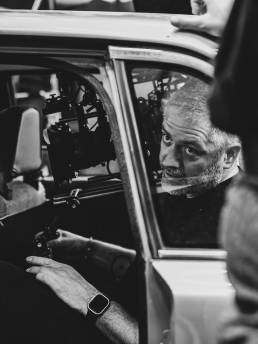
Photo credit to to: Fredrik Törnqvist
Meet DOP Michael Tebinka
Michael Tebinka is a Sweden-based cinematographer of Polish heritage, with a creative background that bridges photojournalism and video art. With more than a decade of experience, he works across commercials, narrative films, documentary, music videos and art-house projects, bringing a sensibility that balances technical precision with a strong emotional point of view. His approach is rooted in presence and participation on set, treating camera movement and blocking almost like choreography, with the goal of placing the viewer inside the moment rather than observing it from a distance.
Educated internationally, Tebinka holds a BA (Hons) in Video Art from Lasalle College of the Arts in Singapore and an MSc in 3D Stereoscopic Media from Ravensbourne University in London.
His commercial and institutional portfolio includes projects for organizations such as National Geographic, Sandvik, Billerud, ALMI, Uppsala University, Sveriges Kommuner and Regioner, Gävle Konstcentrum, Singapore Telecommunications, the Singapore Mass Rapid Transport System Awards, and the ASEAN Para Games. Alongside client work, his cinematography has been recognized internationally through multiple awards. In 2021 he received Best International Cinematography for Tomorrow Island at the Kinofilm Manchester International Short Film Festival in the UK. The same film received Silver for Best Cinematography at the Queenpalm International Film Festival in the USA in 2019. In 2020, his project Blackout won the ARRI Unspoken Nordic Challenge in Sweden.
The Athens challenge: small case, real production
For Athens, Michael had a three-day production with a high scene count, mixing interiors and exteriors, built around a small travel-ready kit. He packed a compact camera setup and made room for a single light, diffusion, filters, and a few essentials in a Peli Air 1535. His choice: Rapida, a 200 W bi-color point source built for fast, minimal setups.
What “one light” actually covered on set
Michael’s article is a great reminder that “simple” doesn’t mean “limited”. Across the shoot, he used Rapida in multiple roles:
Backlight + ambience in a dark interior, adding separation and fill (around 3200K).
Gel work for depth and separation, combining Rosco gels (including Storaro Indigo and Storaro Red) to shape the hallway mood.
Punchy daylight key through sheers, using the 20° spot optic to extend daylight continuity and keep a consistent look even after the sun dropped.
Night terrace in the rain, placing Rapida like a motivated streetlight to bring out raindrops and add backlight and bounce from wet surfaces.
That last one matters, because it’s not a lab test. It’s the kind of “real life” scenario where speed, robustness, and predictability either show up… or don’t.
The takeaway: simplicity as a creative advantage
One point we really liked is that Michael doesn’t present this as a hype-driven review. He’s clear that he’s hard to impress, and that for him “trust” is earned by day-after-day reliability on set. His conclusion is essentially a philosophy: minimal controls, fast handling, high-quality light, and a form factor that makes you more willing to bring the light in the first place.
He also shares one small critique from real use: at very low output levels, knob-based adjustment can feel less precise, and the dimming curve didn’t feel perfectly smooth to him in that extreme range. That kind of note is valuable, because it comes from an actual production context, not a spec sheet.
In his own words: the experience with Maxima
In Athens, Rapida wasn’t treated like a studio light. It was treated like a real production tool: packed small, moved fast, pushed through interiors and exteriors, shaped with optics, filtered with gels, and trusted even when the weather turned. That is where a fixture earns its place. Not in specs, but in the quiet confidence that it will deliver the moment you need it. My experience with Maxima is a reminder that simplicity, when it’s built on quality and reliability, doesn’t reduce creative options. It expands them.


